Openapi Track Partner of the AI Accessibility Hackathon: our APIs for inclusive AI
Over 100 young talents, 8 hours of building and practical tools to break down accessibility barriers for blind and Deaf people.

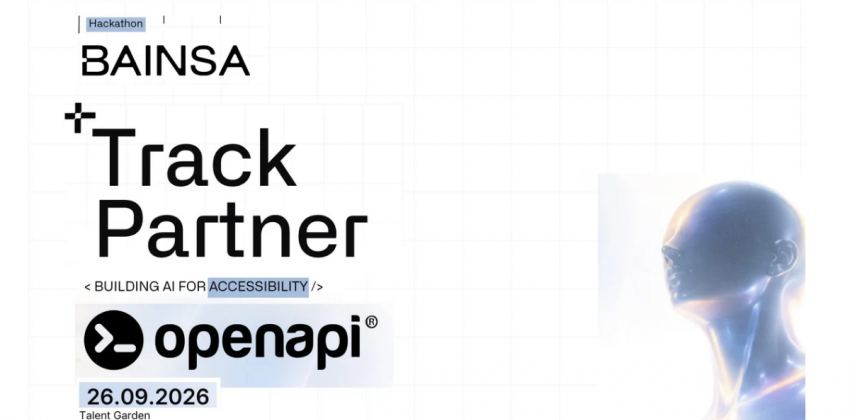
On Saturday 26 September, Talent Garden Milan hosted the AI Accessibility Hackathon, a day of building organised by BAINSA in collaboration with Anthropic. The goal was clear: use artificial intelligence to reduce the accessibility barriers that blind and Deaf people face every day in digital and professional environments.
Openapi took part in the initiative as Track Partner of the track dedicated to accessibility. We supported over 100 students and young developers from Milan’s leading universities as they built working prototypes, standing alongside the people who are building the technologies of tomorrow.
A hackathon for truly accessible AI
Digital accessibility is still one of the open challenges of innovation. Many of the tools we use every day to work, communicate and stay informed are not designed for people with visual or hearing impairments.
For eight hours, teams worked on real, documented barriers. They used Claude, the AI model developed by Anthropic, as their core technology and were supported by industry mentors. At the end of the day, they presented working prototypes to a final jury. No ideas on paper: tools designed to solve real problems.
BAINSA, the student-led AI research lab
BAINSA (Board of AI & Neuroscience Associations) is the largest student-led artificial intelligence research lab in Italy. Founded in 2022, it has labs at Bocconi, Politecnico di Milano and Sapienza. It brings together students in AI, neuroscience, data science, quantitative research and applied technology.
Its activities range from technical projects and research reviews to workshops, demos, hackathons and industry events. It is a selective community: 70 members and a 10% acceptance rate.
Openapi’s role at the AI Accessibility Hackathon
As Track Partner, Openapi contributed to the accessibility track in two ways:
- Credit on the Openapi platform: teams had access to our APIs to integrate messaging and communication services into the prototypes they developed during the day.
- Jury: Luca Scuriatti, CEO of Openapi, was part of the hackathon jury and helped evaluate the projects presented.
For us, it was an opportunity to meet a new generation of developers up close and see how they tackle complex problems with the most advanced tools available.
The event in numbers
- Over 100 participants, including students and young developers.
- 8 hours of building.
- Multiple universities involved: Bocconi, Politecnico di Milano and other Milan universities.
- Diverse backgrounds among participants: computer science, mathematics, engineering, data science and economics.
APIs and AI: tools for inclusive innovation
Accessibility works best as a design principle, not as a feature added at the end. For that to happen, developers need tools that are reliable, easy to integrate and ready to use.
This is where AI and APIs work together. AI models open up new ways of interacting. APIs make it possible to connect essential services, such as messaging and communications, quickly and securely. Builders can then focus on the problem they want to solve rather than on the infrastructure.
Openapi’s commitment to tech talent
As a leading API marketplace in Europe, Openapi supports initiatives that put the people driving innovation at the centre. Taking part in the AI Accessibility Hackathon as Track Partner reaffirms our mission: making data and services accessible, easy to integrate and ready to use, for anyone who wants to build something useful.
Because the best technology is the kind that works for everyone.

RELATED ARTICLES

Carbon free energy for Our Cloud  Low CO2





© 2024 Openapi SpA, a single-member company, under the direction and control of Open Holding Srl.
Viale Filippo Tommaso Marinetti 221 - 00143 Rome - Business Register: 1378273, Share Capital: €50,000.00, VAT Number: IT12485671007, Recipient Code: 'USAL8PV' - Certified Email: 
Openapi is certified in: Quality System **UNI EN ISO 9001:2015** - Data Quality **ISO 25012:2014** - Security Management **ISO/IEC 27001:2022** - Gender Equality According UNI PdR 125:2022
All prices are net of any VAT, stamp duty, registration fees, or other taxes that may be due. All logos listed on the portal are copyrighted and owned by their respective owners.