Audire wins the Silent Specs track at the AI Accessibility Hackathon
Three Bocconi students built an assistant that helps Deaf people understand who is speaking, how they mean it and when they’re being addressed.

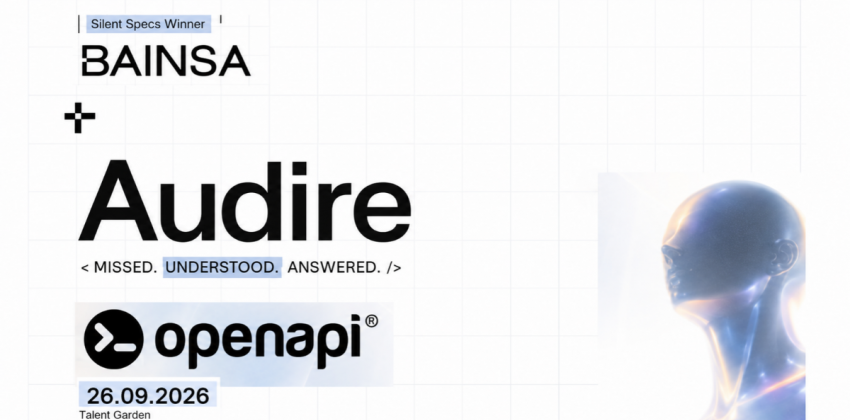
The AI Accessibility Hackathon has come to a close. Organised by BAINSA in collaboration with Anthropic at Talent Garden Milan, the day brought together over 100 students and young developers, who spent 8 hours building practical tools to support blind and Deaf people.
Openapi took part in the event as a partner. One of the tracks was “Silent Specs”, dedicated to Deaf and hard-of-hearing people. The winner was Audire, the project by Zihan (Cassius) Huang, Leo Zuo and Jia Jia Dai, who received credit on the Openapi platform as their prize.
The challenge: recovering what gets lost in the moment
The track’s question was clear: how can we help Deaf and hard-of-hearing people recover the information, context and meaning they miss during a conversation?
The team started the day by testing live captions on different video call platforms. The words came through fine. What got lost was everything else: who was speaking, whether a “sì, va bene” (“yes, fine”) was a genuine yes or a reluctant one, whether the last line was a question aimed at you. Captions tell you what was said, but not who said it, how, or to whom.
Audire: beyond captions
That’s how Audire was born, from the Latin for “to listen”: a companion for live group conversations that captures everything a voice carries beyond the words.
- Who is speaking and where: each voice appears on a map of the table, recognised by timbre and pitch. Side conversations are split into their own columns, so users can choose whom to follow.
- When it’s meant for you: when someone says your name, Audire shows who spoke and what the question refers to, with three replies ready to go.
- How it was said: next to every caption is a word describing the tone, such as question, reluctant or joking, measured against the speaker’s usual voice. A flag highlights moments when words and tone don’t match, like a half-hearted yes or an ironic remark.
- A voice for those who sign: the camera reads hands and face. An open palm makes the laptop say “One moment, I want to answer”, while signs and fingerspelling become a spoken sentence.
Missed, understood and answered, all in the same minute.
The team
Audire was created by three students from Bocconi University:
- Zihan (Cassius) Huang, BSc in International Economics and Management (BIEM).
- Leo Zuo, Master of Science in Management (MiM).
- Jia Jia Dai, BSc in Economics, Management and Computer Science (BEMACS).
How it was built
Audire runs directly in the browser. Speech recognition and text-to-speech come from the browser, MediaPipe tracks hands and faces for signing, and Meyda analyses voice features to tell speakers apart. Claude rewrites the captions, detects when a line is meant for the user and drafts replies.
Most of the app was built during the day with Claude Code. For the team, the real challenge wasn’t writing the code:
“Transcription is no longer the hard part. Building with AI made it clear that the real work is deciding exactly what the user needs and cutting everything else. We dropped our first idea halfway through the day for that reason.” — Zihan (Cassius) Huang
The Openapi prize and next steps
As winners of the track, the team received credit on the Openapi platform. They plan to use it for market research and to automate parts of that work as they turn the prototype into a proper MVP.
The next steps are clear. Today Audire uses a single laptop microphone: it can tell apart people taking turns, but not two people talking over each other. The team wants to move to a microphone array and, above all, test the app with Deaf and hard-of-hearing users, something that couldn’t be done in a single day.
The project’s code is available on GitHub.
What the day left behind
“How much a small team can do when everyone takes it seriously and works together efficiently. Even under competitive pressure, we came up with valuable ideas surprisingly fast.” — Leo Zuo
For Openapi, it was a chance to see the talent of a new generation of developers up close. As a partner of the event, with our CEO Luca Scuriatti on the jury, we continue to support those who use technology to solve real problems, and we’re happy to be part of Audire’s next steps.
Because the best technology is the kind that works for everyone.


Carbon free energy for Our Cloud  Low CO2





© 2024 Openapi SpA, a single-member company, under the direction and control of Open Holding Srl.
Viale Filippo Tommaso Marinetti 221 - 00143 Rome - Business Register: 1378273, Share Capital: €50,000.00, VAT Number: IT12485671007, Recipient Code: 'USAL8PV' - Certified Email: 
Openapi is certified in: Quality System **UNI EN ISO 9001:2015** - Data Quality **ISO 25012:2014** - Security Management **ISO/IEC 27001:2022** - Gender Equality According UNI PdR 125:2022
All prices are net of any VAT, stamp duty, registration fees, or other taxes that may be due. All logos listed on the portal are copyrighted and owned by their respective owners.