

Synchronous and Asynchronous APIs
What they are, what the differences are, and how to use them to build an efficient and scalable architecture

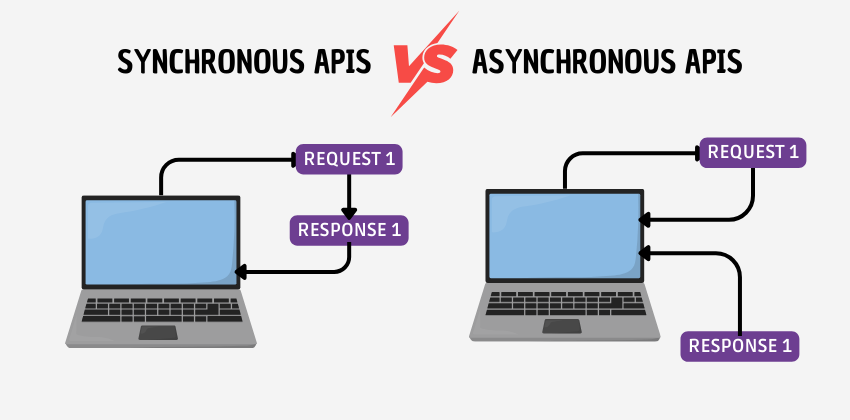
The APIs (Application Programming Interface) work according to a request-response model: in an API call, the client sends a request to the server, which replies by providing the requested data or a message. This general scheme can be implemented in two execution modes: synchronous and asynchronous.
The distinction between these two models is not merely theoretical; it significantly affects the design of scalable and efficient systems. This is why the correct implementation of synchronous and asynchronous interaction mechanisms is a key feature of every modern application architecture.
Synchronous APIs: what they are and how they work
In a synchronous API, communication happens in real time: the client sends a request to the server and waits until it receives the response. During this time, the client cannot perform other operations or send additional requests on the same thread, which is why we refer to a “blocking” mechanism.
This type of API is ideal for fast operations, such as retrieving geocoding data for satellite navigation or updating a shared database. The server’s response is practically immediate and generally contains the requested data or confirmation that a certain command has been executed, such as deleting a resource or sending a message.
Synchronous APIs are very common in web microservices because they allow immediate feedback and are simple to implement. On the other hand, this communication model requires the client to wait for the server's response before doing anything else. This means it is only suitable when the processing time is very short. In some applications — such as uploading and analyzing a large video file or generating a financial report — this mechanism may become inefficient and hinder system scalability.
What are asynchronous APIs?
Unlike synchronous APIs, asynchronous APIs operate according to a request-accept-notify model: when the client sends a request, the server responds by confirming that it has accepted the operation. The typical response code is “202 Accepted”, and usually the response also includes an ID used to retrieve the final result when it’s ready. At that point, the client is free to handle other requests (a “non-blocking” mechanism).
When the server has processed the request, it will send the result back to the client. This can happen in two ways:
- Polling: the client periodically checks the server until the response is ready (Pull model);
- Callback / Webhook: when the response is ready, the server calls a client URL to notify that the operation has completed (Push model).
Asynchronous APIs are essential in scenarios where response times are long, such as processing videos and documents. The main advantage of this architectural choice is the complete absence of waiting times, which allows for optimal use of computing and network resources. On the other hand, asynchronous flows are more complex to configure because they require, among other things, notification management.
Differences between synchronous and asynchronous APIs
To summarize the differences between synchronous and asynchronous APIs, we can say they concern:
- Workflow: synchronous APIs block the client while waiting for the response, while asynchronous APIs provide the reference needed to “retrieve” the response and immediately free the client;
- Use cases: synchronous APIs are perfect for short and fast operations, while asynchronous ones are preferable for any processing that takes more than a few milliseconds or involves job queues;
- Response delivery: synchronous APIs deliver the response immediately, whereas asynchronous APIs do so via subsequent notification mechanisms (polling or callback);
- Complexity: asynchronous APIs are more complex to implement because they must manage the operation state over time and require notification mechanisms shared with the client (who must handle polling cycles or expose a callback endpoint).
Many modern applications use hybrid architectures where both synchronous and asynchronous APIs are used depending on the need. In any e-commerce platform, for example, operations such as cart validation and payment authorization use synchronous communication, while follow-up operations such as order confirmation emails and invoice generation occur asynchronously.
When to use synchronous and asynchronous APIs
The choice between synchronous and asynchronous APIs fundamentally depends on the execution time of the operation and the need for an immediate response on the client side. If the client needs the response before proceeding, synchronous communication is the best option. Typical examples include authentication processes, where the server must immediately verify user credentials, and the retrieval of real-time data needed for loading images or retrieving product metadata on an e-commerce page.
Asynchronous APIs are the right choice for any operation requiring more than a few milliseconds. Common examples include processing large files, where conversion or import can occur in the background while the client performs other tasks, and sending mass emails, which are accepted immediately and processed over time.
If processing can take place in the background without blocking the client and there is no need for immediate feedback, the asynchronous architecture is the most efficient choice, especially in environments handling many resources, such as stock trading platforms where historical data aggregation takes time but must not block real-time operations.

RELATED ARTICLES

Carbon free energy for Our Cloud  Low CO2





© 2024 Openapi SpA, a single-member company, under the direction and control of Open Holding Srl.
Viale Filippo Tommaso Marinetti 221 - 00143 Rome - Business Register: 1378273, Share Capital: €50,000.00, VAT Number: IT12485671007, Recipient Code: 'USAL8PV' - Certified Email: 
Openapi is certified in: Quality System **UNI EN ISO 9001:2015** - Data Quality **ISO 25012:2014** - Security Management **ISO/IEC 27001:2022** - Geneder Equality According UNI PdR 125:2022
All prices are net of any VAT, stamp duty, registration fees, or other taxes that may be due. All logos listed on the portal are copyrighted and owned by their respective owners.